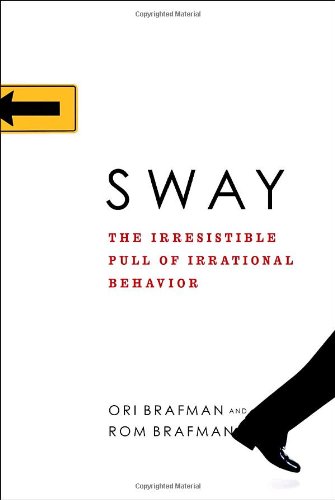
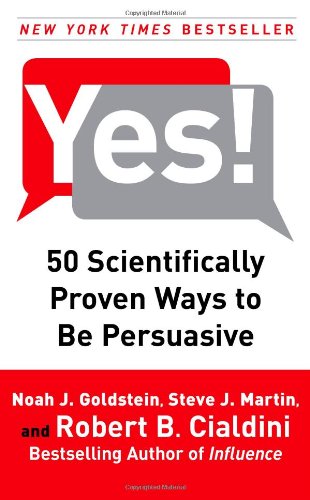
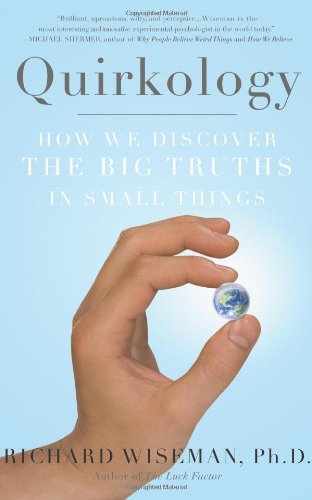
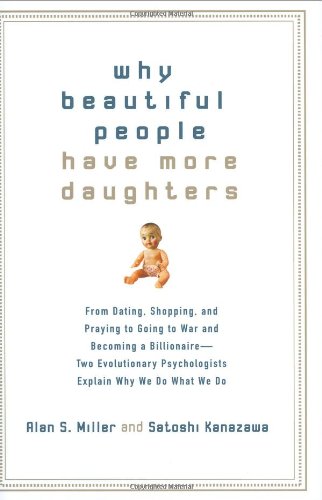
Quirkology
Discover the hidden forces shaping our choices with the Quirkology reading list. Explore Freakonomics, Blink, Nudge, and more—unlocking the psychology, economics, and irrational logic behind everyday decisions.

Book
Freakonomics Rev Ed
by Steven D. Levitt
Which is more dangerous, a gun or a swimming pool? What do schoolteachers and sumo wrestlers have in common? Why do drug dealers still live with their moms? How much do parents really matter? How did the legalization of abortion affect the rate of violent crime? These may not sound like typical questions for an econo-mist to ask. But Steven D. Levitt is not a typical economist. He is a much-heralded scholar who studies the riddles of everyday life—from cheating and crime to sports and child-rearing—and whose conclusions turn conventional wisdom on its head. Freakonomics is a groundbreaking collaboration between Levitt and Stephen J. Dubner, an award-winning author and journalist. They usually begin with a mountain of data and a simple question. Some of these questions concern life-and-death issues; others have an admittedly freakish quality. Thus the new field of study contained in this book: freakonomics. Through forceful storytelling and wry insight, Levitt and Dubner show that economics is, at root, the study of incentives—how people get what they want, or need, especially when other people want or need the same thing. In Freakonomics, they explore the hidden side of . . . well, everything. The inner workings of a crack gang. The truth about real-estate agents. The myths of campaign finance. The telltale marks of a cheating schoolteacher. The secrets of the Klu Klux Klan. What unites all these stories is a belief that the modern world, despite a great deal of complexity and downright deceit, is not impenetrable, is not unknowable, and—if the right questions are asked—is even more intriguing than we think. All it takes is a new way of looking. Freakonomics establishes this unconventional premise: If morality represents how we would like the world to work, then economics represents how it actually does work. It is true that readers of this book will be armed with enough riddles and stories to last a thousand cocktail parties. But Freakonomics can provide more than that. It will literally redefine the way we view the modern world.




Book
Why Choose this Book?
by Read Montague
To the list of writers connecting mainstream readers and cutting-edge science ;Malcolm Gladwell, Steven Johnson, James Surowiecki ;add Read Montague, with this exploration of what exactly determines the choices we make. With a new perspective on the science of decision-making from the researcher at the center of the computational neuroscience revolution, Why Choose This Book?shows what the latest brain science reveals about the crucial events of everyday experience ;the choices we make. From how we decide what we consume to what kind of art we like, and even the romantic, ethical, and financial choices we make, Read Montague guides the reader through a new approach to the mind with an accessible style that is both entertaining and illuminating. In taking apart the mind's decision-making machinery, Montague first illustrates how our brains are like computers that are slow, small, fuzzy, and cheap ;and began with goals like food, water, and sex. Second, he reveals how simple goals like these then turn into ideas like beauty, love, and terror with a life of their own. Finally, he explains how a value system in our heads controls those ideas so we can make good decisions ;and how that physical system can break down leading to bad decisions, addictions, mental illness, and even large economic disasters.


Book
The Undercover Economist
by Tim Harford
“The economy [isn’t] a bunch of rather dull statistics with names like GDP (gross domestic product),” notes Tim Harford, columnist and regular guest on NPR’s Marketplace, “economics is about who gets what and why.” In this acclaimed and riveting book–part exposé, part user’s manual–the astute and entertaining columnist from the Financial Times demystifies the ways in which money works in the world. From why the coffee in your cup costs so much to why efficiency is not necessarily the answer to ensuring a fair society, from improving health care to curing crosstown traffic–all the dirty little secrets of dollars and cents are delightfully revealed by The Undercover Economist. “A rare specimen: a book on economics that will enthrall its readers . . . It brings the power of economics to life.” –Steven D. Levitt, coauthor of Freakonomics “A playful guide to the economics of everyday life, and as such is something of an elder sibling to Steven Levitt’s wild child, the hugely successful Freakonomics.” –The Economist “A tour de force . . . If you need to be convinced of the everrelevant and fascinating nature of economics, read this insightful and witty book.” –Jagdish Bhagwati, author of In Defense of Globalization “This is a book to savor.” –The New York Times “Harford writes like a dream. From his book I found out why there’s a Starbucks on every corner [and] how not to get duped in an auction. Reading The Undercover Economist is like spending an ordinary day wearing X-ray goggles.” –David Bodanis, author of Electric Universe “Much wit and wisdom.” –The Houston Chronicle From Publishers Weekly Nattily packaged-the cover sports a Roy Lichtensteinesque image of an economist in Dick Tracy garb-and cleverly written, this book applies basic economic theory to such modern phenomena as Starbucks' pricing system and Microsoft's stock values. While the concepts explored are those encountered in Microeconomics 101, Harford gracefully explains abstruse ideas like pricing along the demand curve and game theory using real world examples without relying on graphs or jargon. The book addresses free market economic theory, but Harford is not a complete apologist for capitalism; he shows how companies from Amazon.com to Whole Foods to Starbucks have gouged consumers through guerrilla pricing techniques and explains the high rents in London (it has more to do with agriculture than one might think). Harford comes down soft on Chinese sweatshops, acknowledging "conditions in factories are terrible," but "sweatshops are better than the horrors that came before them, and a step on the road to something better." Perhaps, but Harford doesn't question whether communism or a capitalist-style industrial revolution are the only two choices available in modern economies. That aside, the book is unequaled in its accessibility and ability to show how free market economic forces affect readers' day-to-day. Copyright © Reed Business Information, a division of Reed Elsevier Inc. All rights reserved. From Bookmarks Magazine Harford exposes the dark underbelly of capitalism in Undercover Economist. Compared with Steven Levitt’s and Stephen J. Dubner’s popular Freakonomics (*** July/Aug 2005), the book uses simple, playful examples (written in plain English) to elucidate complex economic theories. Critics agree that the book will grip readers interested in understanding free-market forces but disagree about Harford’s approach. Some thought the author mastered the small ideas while keeping in sight the larger context of globalization; others faulted Harford for failing to criticize certain economic theories and to ground his arguments in political, organizational structures. Either way, his case studies—some entertaining, others indicative of times to come—will make you think twice about that cup of coffee. Copyright © 2004 Phillips & Nelson Media, Inc.

Book
The Logic of Life
by Tim Harford
Analyzes the underlying economic logic behind seemingly irrational behavior, explaining how people are responding to future costs and benefits and how socially tragic outcomes have their roots in individually rational decisions.


Book
A Mathematician Reads the Newspaper
by John Allen Paulos
The author examines the role of mathematics in understanding social issues.


Book
Stumbling on Happiness
by Daniel Todd Gilbert
A witty reflection on human nature describes all that science has to tell us about the uniquely human ability to envision the future, and how likely we are to enjoy it when we get there.