Noam Chomsky
Explore a curated list of books by Noam Chomsky, the renowned linguist and political thinker. Discover his influential works on language, media, and global politics in one comprehensive collection.


Book
Understanding Power
by Peter R. Mitchell
An introduction to Noam Chomsky's views on the politics of power discusses third-party politics in the United States, the suppression of dissent, U.S. foreign and domestic policy, and the role of the media.

Book
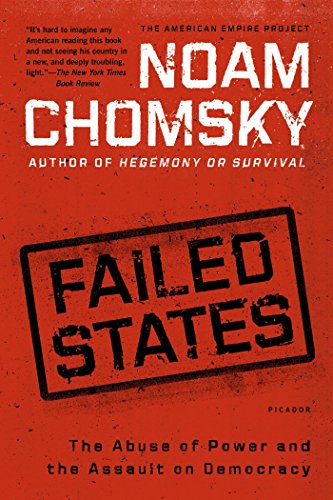
Failed States
by Noam Chomsky
"It's hard to imagine any American reading this book and not seeing his country in a new, and deeply troubling, light."—The New York Times Book Review The United States has repeatedly asserted its right to intervene militarily against "failed states" around the globe. In this much-anticipated follow-up to his international bestseller Hegemony or Survival, Noam Chomsky turns the tables, showing how the United States itself shares features with other failed states—suffering from a severe "democratic deficit," eschewing domestic and international law, and adopting policies that increasingly endanger its own citizens and the world. Exploring the latest developments in U.S. foreign and domestic policy, Chomsky reveals Washington's plans to further militarize the planet, greatly increasing the risks of nuclear war. He also assesses the dangerous consequences of the occupation of Iraq; documents Washington's self-exemption from international norms, including the Geneva conventions and the Kyoto Protocol; and examines how the U.S. electoral system is designed to eliminate genuine political alternatives, impeding any meaningful democracy. Forceful, lucid, and meticulously documented, Failed States offers a comprehensive analysis of a global superpower that has long claimed the right to reshape other nations while its own democratic institutions are in severe crisis. Systematically dismantling the United States' pretense of being the world's arbiter of democracy, Failed States is Chomsky's most focused—and urgent—critique to date.

Book
Manufacturing Consent
by Edward S. Herman
A "compelling indictment of the news media's role in covering up errors and deceptions" (The New York Times Book Review) due to the underlying economics of publishing—from famed scholars Edward S. Herman and Noam Chomsky. With a new introduction. In this pathbreaking work, Edward S. Herman and Noam Chomsky show that, contrary to the usual image of the news media as cantankerous, obstinate, and ubiquitous in their search for truth and defense of justice, in their actual practice they defend the economic, social, and political agendas of the privileged groups that dominate domestic society, the state, and the global order. Based on a series of case studies—including the media’s dichotomous treatment of “worthy” versus “unworthy” victims, “legitimizing” and “meaningless” Third World elections, and devastating critiques of media coverage of the U.S. wars against Indochina—Herman and Chomsky draw on decades of criticism and research to propose a Propaganda Model to explain the media’s behavior and performance. Their new introduction updates the Propaganda Model and the earlier case studies, and it discusses several other applications. These include the manner in which the media covered the passage of the North American Free Trade Agreement and subsequent Mexican financial meltdown of 1994-1995, the media’s handling of the protests against the World Trade Organization, World Bank, and International Monetary Fund in 1999 and 2000, and the media’s treatment of the chemical industry and its regulation. What emerges from this work is a powerful assessment of how propagandistic the U.S. mass media are, how they systematically fail to live up to their self-image as providers of the kind of information that people need to make sense of the world, and how we can understand their function in a radically new way.

Book
Hegemony or Survival
by Noam Chomsky
"Reading Chomsky today is sobering and instructive . . . He is a global phenomenon . . . perhaps the most widely read voice on foreign policy on the planet." -The New York Times Book Review An immediate national bestseller, Hegemony or Survival demonstrates how, for more than half a century the United States has been pursuing a grand imperial strategy with the aim of staking out the globe. Our leaders have shown themselves willing-as in the Cuban missile crisis-to follow the dream of dominance no matter how high the risks. World-renowned intellectual Noam Chomsky investigates how we came to this perilous moment and why our rulers are willing to jeopardize the future of our species. With the striking logic that is his trademark, Chomsky tracks the U.S. government's aggressive pursuit of "full spectrum dominance" and vividly lays out how the most recent manifestations of the politics of global control-from unilateralism to the dismantling of international agreements to state terrorism-cohere in a drive for hegemony that ultimately threatens our existence. Lucidly written, thoroughly documented, and featuring a new afterword by the author, Hegemony or Survival is a definitive statement from one of today's most influential thinkers. Noam Chomsky was born in Philadelphia, Pennsylvania, on December 7, 1928. He studied linguistics, mathematics, and philosophy at the University of Pennsylvania. In 1955, he received his Ph.D. from the University of Pennsylvania and began teaching at the Massachusetts Institute of Technology, where he is a Professor in the Department of Linguistics and Philosophy. During the years 1951 to 1955, Chomsky was a Junior Fellow of the Harvard University Society of Fellows. While a Junior Fellow he completed his doctoral dissertation entitled, "Transformational Analysis." The major theoretical viewpoints of the dissertation appeared in the monograph Syntactic Structure, which was published in 1957 and is widely credited with having revolutionized the field of modern linguistics. This formed part of a more extensive work, The Logical Structure of Linguistic Theory, circulated in mimeograph in 1955 and published in 1975. In 1961, Chomsky was appointed full professor in the Department of Modern Languages and Linguistics (now the Department of Linguistics and Philosophy) at MIT. From 1966 to 1976 he held the Ferrari P. Ward Professorship of Modern Languages and Linguistics. In 1976 he was appointed Institute Professor, a position he held until 2002. Chomsky is the author of numerous works, including Hegemony or Survival. He is also the author of 9-11 (Seven Stories Press), Rogue States (South End Press), Understanding Power (New Press), New Horizons in the Study of Language and Mind (Cambridge University Press), The Minimalist Program (MIT Press), and many other titles. In 1988, Chomsky received the Kyoto Prize in Basic Science, given "to honor those who have contributed significantly to the scientific, cultural, and spiritual development of mankind." The p0prize noted that "Dr. Chomsky's theoretical system remains an outstanding monument of 20th century science and thought. He can certainly be said to be one of the great academicians and scientists of this century." Chomsky lives in Lexington, Massachusetts. For more than half a century, the United States has been pursing a grand imperial strategy with the aim of staking out the globe. Our leaders have shown themselves willing—as in the Cuban missile crisis—to follow the dream of dominance no matter how high the risks. Now the Bush administration is intensifying this process, driving us toward the final frontiers of imperial control, toward a choice between the prerogatives of power and a livable Earth. In Hegemony or Survival, Noam Chomsky investigates how we came to this moment, what kind of peril we find ourselves in, and why our rulers are willing to jeopardize the future of our species. With the striking logic that is his trademark, Chomsky dissects America's quest for global supremacy, tracking the U.S. government's aggressive pursuit of policies intended to achieve "full spectrum dominance" at any cost. He vividly lays out how the most recent manifestations of the politics of global control—from unilateralism and the dismantling of international agreements to state terrorism and the militarization of space—cohere in a drive for hegemony that ultimately threatens our survival. In our era, he argues, empire is a recipe for an earthy wasteland. Lucid, rigorous, and thoroughly documented, Hegemony or Survival is Chomsky's most urgent and sweeping work in years. Certain to spark widespread debate, it is a definitive statement from one of the world's most influential political thinkers. "A thoughtful, well-argued antidote to the conventional wisdom. [Chomsky] is a national resource, never afraid to challenge power, and is solidly within the honoured tradition of American radicalism."—Ronald Steel, The Nation "[Chomsky] may be the most widely read American voice on foreign policy on the planet today . . . [In this book, he] argues that the Bush administration's war on terrorism builds upon a long tradition of foreign interventions carried out in the name of 'liberation' or 'counterterror,' of special interests run amok and of disdain for international institutions that dare to challenge American hegemony . . . Because every state justifies its wars on the grounds of self-defense or altruism, Chomsky is correct that any 'profession of noble intent is predictable, and therefore carries no information.' He is also right to object to the historical amnesia that American statesmen bring to their dealings with other states. He seethes at the hypocrisy of Donald Rumsfeld, Paul Wolfowitz, and Colin Powell, who invoked Saddam Hussein's 1988 gassing attacks in order to help justify the recent war, but who did not see fit to explain why the Reagan administration (which they served as senior officials) doubled its aid to Hussein's regime after learning of the gassings . . . And it is essential to demand, as Chomsky does, that a country with the might of the U.S. stop being so selective in applying its principles. We will not allow our sovereignty to be infringed by international treaty commitments in the areas of human rights or even arms control, but we demand that others should. We rebuff the complaints of foreigners about the 650 people who remain holed up in Guantánamo kennels, denied access to lawyers and family members, with not even their names released. Yet we expect others to take heed of our protests about due process. We have 'official enemies'—those whose police abuses, arms shipments, and electoral thefts we eagerly expose (Zimbabwe, Burma, North Korea, Iran). But the sins of our allies in the war on terror (Saudi Arabia, Turkey, Israel, Pakistan, Russia, Uzbekistan) are met with 'intentional ignorance' . . . [Chomsky] is right to demand that officials in Washington devote themselves more zealously to strengthening international institutions, curbing arms flows, and advancing human rights."—Samantha Power, The New York Times Book Review "With relentless logic, Chomsky bids us to listen closely to what our leaders tell us—and to discern what they are leaving out . . . Agree with him or not, we lose out by not listening."—Business Week "If, for reasons of chance, or circumstance, (or sloth), you have to pick just one book on the subject of the American Empire, pick this one. It's the Full Monty. It's Chomsky at his best. Hegemony or Survival is necessary reading."—Arundhati Roy "Recent developments, above all the Iraq War, affirm what Chomsky has known all along: The United States is a terrorist state—odious, immoral, drunk on its own wild ambitions, and a threat to all mankind. As a consequence, Americans today find themselves trapped in a 'nightmare' of the nation's own making. [Chomsky maintains that] awakening from that nightmare requires that the U.S. abandon its ambitions of global hegemony and accept the imperative of radical political reform . . . Chomsky is correct that in its relations with the rest of the world the United States has been guilty of inconsistency and mendacity and of deploying its professed ideals to disguise acts of naked self-interest . . . [He is also] right in noting that America today has arrogated to itself something akin to imperial prerogatives."—Andrew J. Bacevich, The Washington Post Book World "It is possible that, if the United States goes the way of nineteenth-century Britain, Chomsky's interpretation will be the standard among historians a hundred years from now."—The New Yorker "Claiming that the U.S. is a rogue nation in its foreign policies and its 'contempt for international law,' Chomsky brings together many themes he has mined in the past, making this cogent and provocative book an important addition to an ongoing public discussion about U.S. f0policy."—Publishers Weekly



Book
Deterring Democracy
by Noam Chomsky
In this highly praised and widely debated book, America's leading dissident intellectual offers a revelatory portrait of the American empire and the danger it poses for democracy, both at home and abroad. Chomsky details the major shift in global politics and economic potency and reveals the potentially catastrophic consequences of this new imbalance.