Complexity & Chaos Theory for Psychologists.
Discover essential books on complexity and chaos theory for psychologists. Explore curated reads like James Gleick's *Chaos* and Philip Ball's *Critical Mass* to deepen your understanding of dynamic systems.

Book
A New Kind of Science
by Stephen Wolfram
Índice: 1. The Foundations for a New Kind of Science -- 2. The Crucial Experiment -- 3. The World of Simple Programs -- 4. Systems Based on Numbers -- 5. Two Dimensions and Beyond -- 6. Starting from Randomness -- 7. Mechanisms in Programs and Nature -- 8. Implications for Everyday Systems -- 9. Fundamental Physics -- 10. Processes of Perception and Analysis -- 11. The Notion of Computation -- 12. The Principle of Computational Equivalence.
Book
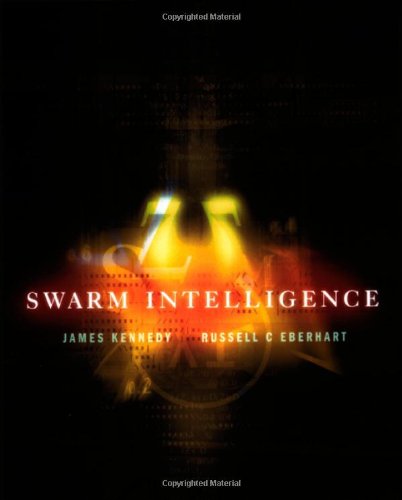
Swarm Intelligence (The Morgan Kaufmann Series in Artificial Intelligence)
No summary available.

Book
Chaos
by James Gleick
James Gleick explains the theories behind the fascinating new science called chaos. Alongside relativity and quantum mechanics, it is being hailed as the twentieth century's third revolution. 8 pages of photos.



Book
Linked
by Albert-László Barabási
We've long suspected that we live in a small world, where everything is connected to everything else. Indeed, networks are pervasive--from the human brain to the Internet to the economy to our group of friends. These linkages, it turns out, aren't random. All networks, to the great surprise of scientists, have an underlying order and follow simple laws. Understanding the structure and behavior of these networks will help us do some amazing things, from designing the optimal organization of a firm to stopping a disease outbreak before it spreads catastrophically. In Linked, Barabási, a physicist whose work has revolutionized the study of networks, traces the development of this rapidly unfolding science and introduces us to the scientists carrying out this pioneering work. These "new cartographers" are mapping networks in a wide range of scientific disciplines, proving that social networks, corporations, and cells are more similar than they are different, and providing important new insights into the interconnected world around us. This knowledge, says Barabási, can shed light on the robustness of the Internet, the spread of fads and viruses, even the future of democracy.


Book
Critical Mass
by Philip Ball
"In searching for answers, the science writer Philip Ball argues that we can enlist help from a seemingly unlikely source: physics. The first person to think this way was the seventeenth-century English philosopher Thomas Hobbes. His approach, described in Leviathan, was based not on utopian wishful thinking, but rather on Galileo's mechanics; it was an attempt to construct a moral and political theory from scientific first principles. Although his solution - absolute monarchy - is unappealing today, Hobbes sparked a new way of thinking about human behavior in looking for the "scientific" rules of society. Adam Smith, Immanuel Kant, Auguste Comte, and John Stuart Mill pursued this same idea from different political perspectives."--BOOK JACKET.