brief Wittgenstein list- suggested reading
Discover the best Wittgenstein books to read with our curated list, featuring David Edmonds' Wittgenstein's Poker for philosophy fans and Thomas Bernhard's Wittgenstein's Nephew, a must-read fiction classic.




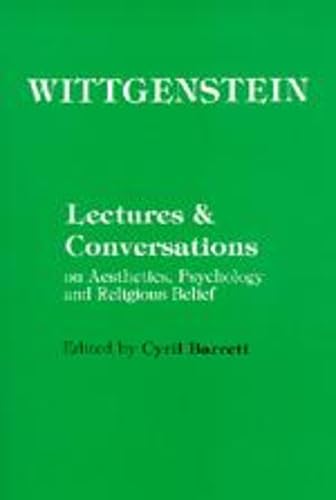
Book
Lectures and conversations on aesthetics, psychology and religious belief
No summary available.

Book
Wittgenstein's Poker
by David Edmonds
On October 25, 1946, in a crowded room in Cambridge, England, the great twentieth-century philosophers Ludwig Wittgenstein and Karl Popper came face to face for the first and only time. The meeting -- which lasted ten minutes -- did not go well. Their loud and aggressive confrontation became the stuff of instant legend, but precisely what happened during that brief confrontation remained for decades the subject of intense disagreement. An engaging mix of philosophy, history, biography, and literary detection, Wittgenstein's Poker explores, through the Popper/Wittgenstein confrontation, the history of philosophy in the twentieth century. It evokes the tumult of fin-de-siécle Vienna, Wittgentein's and Popper's birthplace; the tragedy of the Nazi takeover of Austria; and postwar Cambridge University, with its eccentric set of philosophy dons, including Bertrand Russell. At the center of the story stand the two giants of philosophy themselves -- proud, irascible, larger than life -- and spoiling for a fight.

Book
Wittgenstein's Nephew
by Thomas Bernhard
It is 1967, in a Viennese hospital. In separate wards: the narrator named Thomas Bernhard, is stricken with a lung ailment; his friend Paul, nephew of Ludwig Wittgenstein, is suffering fom one of his periodic bouts of madness. Bernhard traces the growth of an intense friendship between two eccentric, obsessive men who share a passion for music, a strange sense of humor, brutal honesty, and a disgust for bourgeois Vienna. "[Wittgenstein's Nephew is] a meditative fugue for mad, brilliant voices on the themes of death, death-in-life and the artist's and thinker's role in society . . . oddly moving and funny at the same time."—Joseph Coates, Chicago Tribune "Mr. Bernhard's memoir about Paul Wittgenstein is a 'confession and a guilty homage to their friendship; it takes the place of the graveside speech he never delivered. In its obsessive, elegant rhythms and narrative eloquence, it resembles a tragic aria by Richard Strauss. . . . This is a memento mori that approaches genius.'"—Richard Locke, Wall Street Journal